
If you spent any time walking between the panel rooms and screening halls of the major film festivals this year, you could be forgiven for thinking you were attending two entirely different industries occupying the same physical space.
Some weeks ago at the Venice Film Festival, AI creative systems like TapNow hosted the panel “AI x Cinema: The 10,000 Parallel Universes Initiative” at the Venice Production Bridge, pitching a future of hyper-scalable, prompt-to-series pipelines to produce works for dedicated creator-focused platforms like Glanze, a new AI-native streaming platform launched by Tamar AI at the 83rd Venice Film Festival.
The independent industry—and not surprisingly, many emerging auteurs—are the ones embracing this technology with open arms due to drastically reduced costs and expanded creative freedom. These are the very types of new voices that festivals like the Mostra have always encouraged and welcomed. Indicative of this shift, the Reply AI Film Festival, which runs in tandem with Venice, welcomed over 3,000 submissions this year. Canadian director Robert Gaudette won first prize with his A Face Only A Mother Could Love, above.
However, there are those who rightly or wrongly maintain a relentless moral stand—giving a resounding “Fuck AI” at every turn and declaring that machine-generated art is inconsequential at best or “slop” at worst.
“We are,” as director Rob Minkoff (The Lion King), serving as a judge for the Reply AI Film Festival, recently noted in an interview in Venice, “living in a bifurcated time.”
It’s an era where the film industry finds itself split down the middle: suspended between the frictionless promise of algorithmic generation and the fierce, protective instinct of human authorship.
The Auteur’s Stand
To the artisan class—the writers, actors, and directors whose crafts were forged through physical limitation—this technological shift is viewed with deep skepticism rather than as democratization.
Yet at Venice, legendary filmmaker Paul Schrader approached the transition with cold, pragmatic realism, pointing out the technological inevitability of synthetic performers and AI actors. He didn’t offer a moral defense so much as an analytical diagnosis of market forces, even noting that his next film, Three Guns at Dawn, is a technology experiment.
This tension played out directly on the ground during festival panels. An insightful discussion on how veterans and jurors navigate these emerging tools while debating the preservation of human authorship can be found in this Venice AI Film Festival Interview Analysis. This video provides a direct look at how Hollywood directors and AI platforms wrestled with the question of technology versus human craft.
Beyond the Prompt: Helter Skelter and the Art of Appropriation
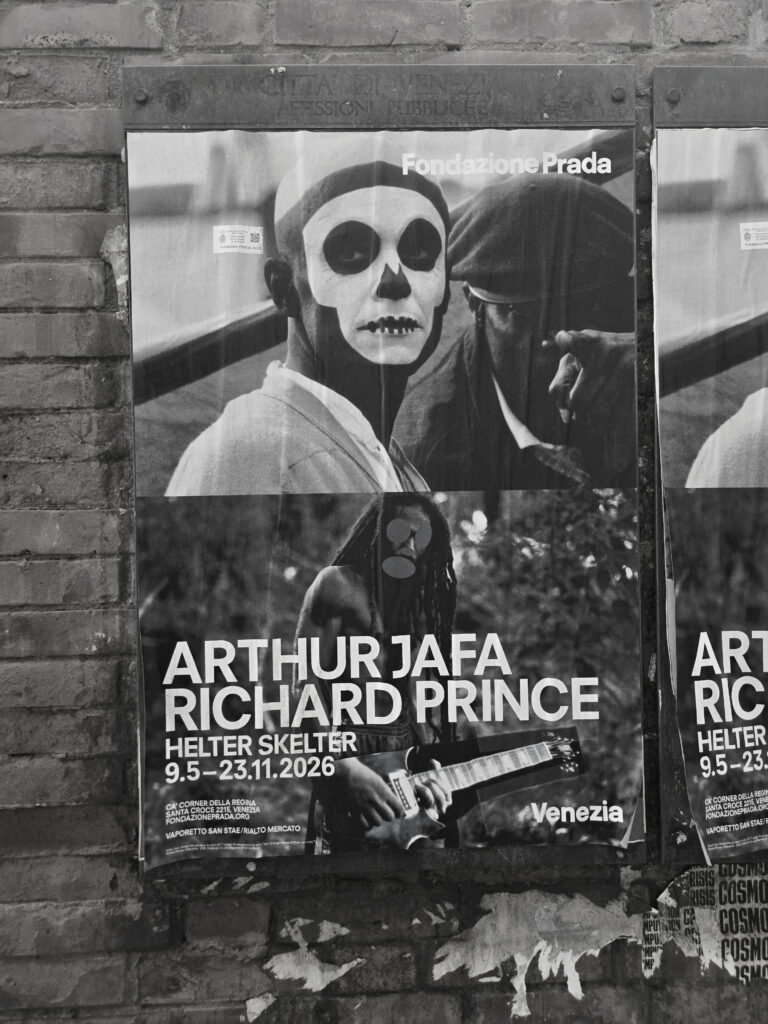
The most compelling debate around synthetic media and digital manipulation wasn’t happening solely at the Mostra; it was taking place at the Venice Biennale proper. It resides in the work of radical artists who use digital tools not to cheapen human intent, but to interrogate it.
Case in point: Arthur Jafa’s BG (2024)—also known as BEN GAZARRA—featured prominently alongside Richard Prince in the Helter Skelter exhibition at Fondazione Prada during the 2026 Venice Biennale.
Jafa didn’t ask an AI generator to invent a movie from scratch. Instead, he took 73 minutes of the violent climax of Martin Scorsese’s Taxi Driver (1976)—ironically written by Paul Schrader—and digitally altered and recast the secondary characters (the pimps and johns originally played by Harvey Keitel and other white actors) with Black performers.
Jafa’s intervention unearths a real, repressed layer of cinema history: Schrader had, quite ironically in light of his comments at Venice, originally written those roles for Black actors. However, Scorsese and the producers altered the casting out of fear of triggering intense racial controversy at the time. Through digital manipulation, Jafa doesn’t create “content out of thin air”—he uses image manipulation as a scalpel to dissect race, systemic violence, and the historical choices embedded in American visual culture.
Jafa’s work highlights the profound difference between AI as a content-generating engine and digital tools as an extension of artistic intent. One seeks to bypass human effort; the other uses technological intervention to provoke deeper human reflection.
Where Do We Stand?
The film industry isn’t facing a simple technological upgrade—it is undergoing a profound identity crisis. The union strikes laid the groundwork for consent, credit, and compensation, but the cultural battle is far from over.
Edward Saatchi, CEO of Fable Studio, noted during an interview in Venice that he is producing an AI feature directed by Zach London (aka Gossip Goblin). Saatchi argues that the unique perspective of AI observing humanity—saying, in effect, “we see you”—is fundamentally new. “Being non-human is new. They’re observing us and our society, and they can see the disconnect between what we say about ourselves and how we behave,” Saatchi stated. “We are at a tipping point where a truly original work of art made by AI can move us and spark curiosity.” London’s film, titled Gods Don’t Give Gifts, is set for a theatrical release this November.
At Woolf+Lapin, we spend every day advocating for singular, visionary voices. As the industry fractures between the “10,000 parallel universes” of automated media and the uncompromising craft of human auteurs, the boutique’s position remains clear:
A machine can synthesize a million frames, process a library of archives, or execute a prompt in seconds. But it takes a human spirit—with all its flaws, history, and political weight—to give those frames a reason to exist.